Why Gold Stays Strong Despite Volatility
Gold refuses to behave the way retail investors expect. Prices swing violently, markets panic, analysts predict collapse—and yet the metal keeps its position untouched. HSBC’s latest breakdown makes one thing clear: gold’s strength has nothing to do with hope, hype, or sentiment. It survives because the global financial system is unstable, and the people who run it know it. When central banks keep buying despite high prices, it should tell you exactly how weak everything else is.
Let’s strip the narrative down to the actual fundamentals instead of the polished commentary floating around.
HSBC’s report notes that gold remains resilient even with extreme price volatility. Retail investors keep calling this behavior “manipulation.” It isn’t manipulation. It’s the reality of an asset that doesn’t depend on quarterly earnings, central bank interest rates, or political promises. Gold holds value because everything around it is unreliable—currencies, markets, governments, debt, and the so-called “stability” of the U.S. dollar.
The primary driver behind gold’s resilience is central bank behavior. When the world’s biggest financial institutions continue purchasing gold despite elevated prices, that signals distrust. Not confidence. They don’t buy gold for returns. They buy it because they don’t trust the long-term direction of fiat currencies. That’s the truth most analysts refuse to say outright.
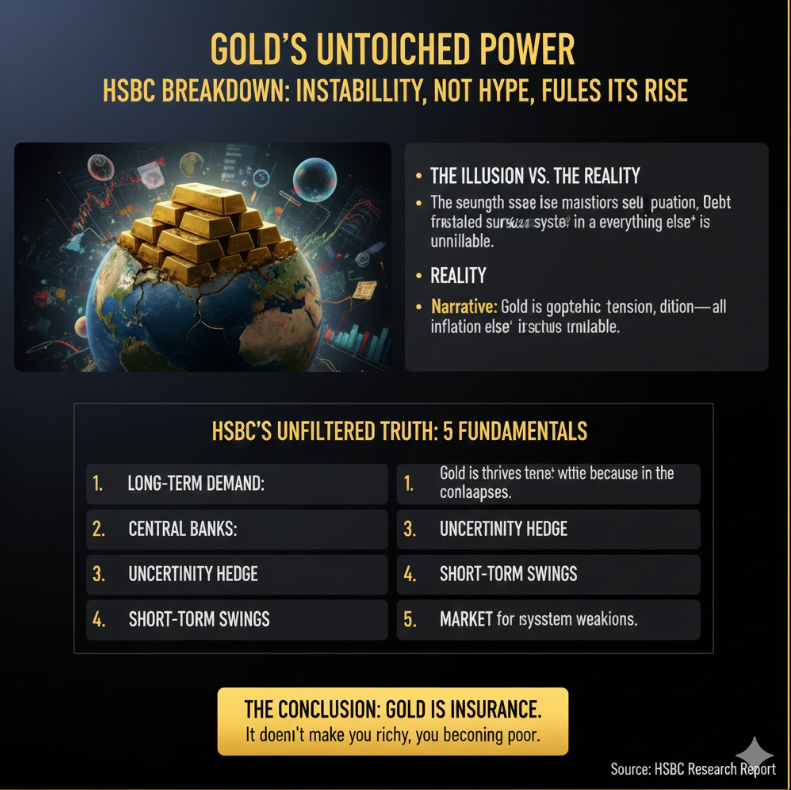
1. Long-term demand drivers haven’t changed
Everyone talks about volatility, but volatility doesn’t matter when the long-term drivers stay untouched. Geopolitical tension isn’t going anywhere. Wars aren’t stopping. Global debt is hitting records every year. Inflation remains stubborn. These factors force gold higher, slowly and continuously, regardless of short-term price swings.
2. Central banks are hoarding gold
They are not scaling back, not pausing, not even slowing. They continue accumulating because they need insurance. If central banks thought inflation was under control or the global economy was stable, they wouldn’t be buying gold at these levels. Their actions expose the weakness of their own policies. They print money, create inflation, then run to gold for protection.
Retail investors talk about timing markets. Central banks don’t care about timing. They care about survival.
3. Gold remains the hedge against uncertainty
This isn’t marketing language. It’s a harsh economic reality. Investors buy gold when they don’t trust the system. Uncertainty today is not temporary—it’s built into the global structure. Governments are drowning in debt. Economies are slowing. Currency value keeps eroding. Confidence in the U.S. dollar—once considered untouchable—is weakening. Gold benefits directly from every one of these failures.
4. Short-term swings don’t matter
HSBC’s strategist Rodolphe Bohn points out that gold’s short-term volatility is irrelevant in the bigger picture. The metal’s role is not to entertain traders. Its purpose is wealth preservation. If someone expects gold to move like equities or crypto, they’re delusional. Gold won’t make you rich quickly. It ensures you don’t become poor when everything else collapses.
That’s why every time the price dips, serious buyers step in.
5. Markets are unstable, so gold strengthens by default
You don’t need gold to be extraordinary. You just need everything else to be worse. And right now, everything else is worse. Bond markets are unreliable. Equities depend on central bank hand-holding. Cryptocurrencies are speculative. Currencies are devaluing at high speed. In that chaos, gold doesn’t need to perform—it simply needs to exist.
The point HSBC is making is simple: gold’s shine remains intact because the world is unstable, not because gold magically improved. Gold is the fallback asset when confidence collapses, and confidence is collapsing everywhere.
The conclusion is straightforward:
If you expect gold to behave like a fast-growth asset, you don’t understand its purpose. Its strength comes from global weakness, and global weakness isn’t going away. If anything, it’s accelerating.