🚨 The Dark Side of Flash Sales: Why Most Deals Are Just Marketing Noise
Flash sales are pure adrenaline—countdowns ticking, "Only 3 left!" banners screaming, and your cart filling up like it's free food at a wedding. But let me be blunt: most flash-sale "deals" are absolute junk. They are perfectly engineered to make you feel like you've won big, while in reality, you're paying close to the normal price (or sometimes, even more).
Below is a straight, human-written breakdown of the psychology and dirty tricks behind flash sales—and the simple system I use to avoid getting played.
1. The Urgency Trap: Time Pressure Kills Logic
- The Trick: Slapping a scary 30-minute timer on the page and watching shoppers panic-buy.
- The Reality Check: Urgency completely shuts down your ability to compare prices and think rationally. Most of the time, that "limited-time" item will return at the same price later, or even cheaper during a quiet monthly sale.
- The Fix: If a deal can’t survive a calm 10-minute pause while you cross-check the price, it's not a deal worth having. Walk away.
2. Fake MRPs & Anchor Pricing
- The Trick: Displaying a ridiculously high MRP (say, $₹2,999$) $\rightarrow$ striking it out $\rightarrow$ flashing a "Sale $₹1,299$!"
- The Reality Check: That product was almost certainly never sold at $₹2,999$. Its normal price is probably $₹1,199$–$₹1,399$ anyway. The huge, struck-out number is just an anchor to make the slightly lower number look good.
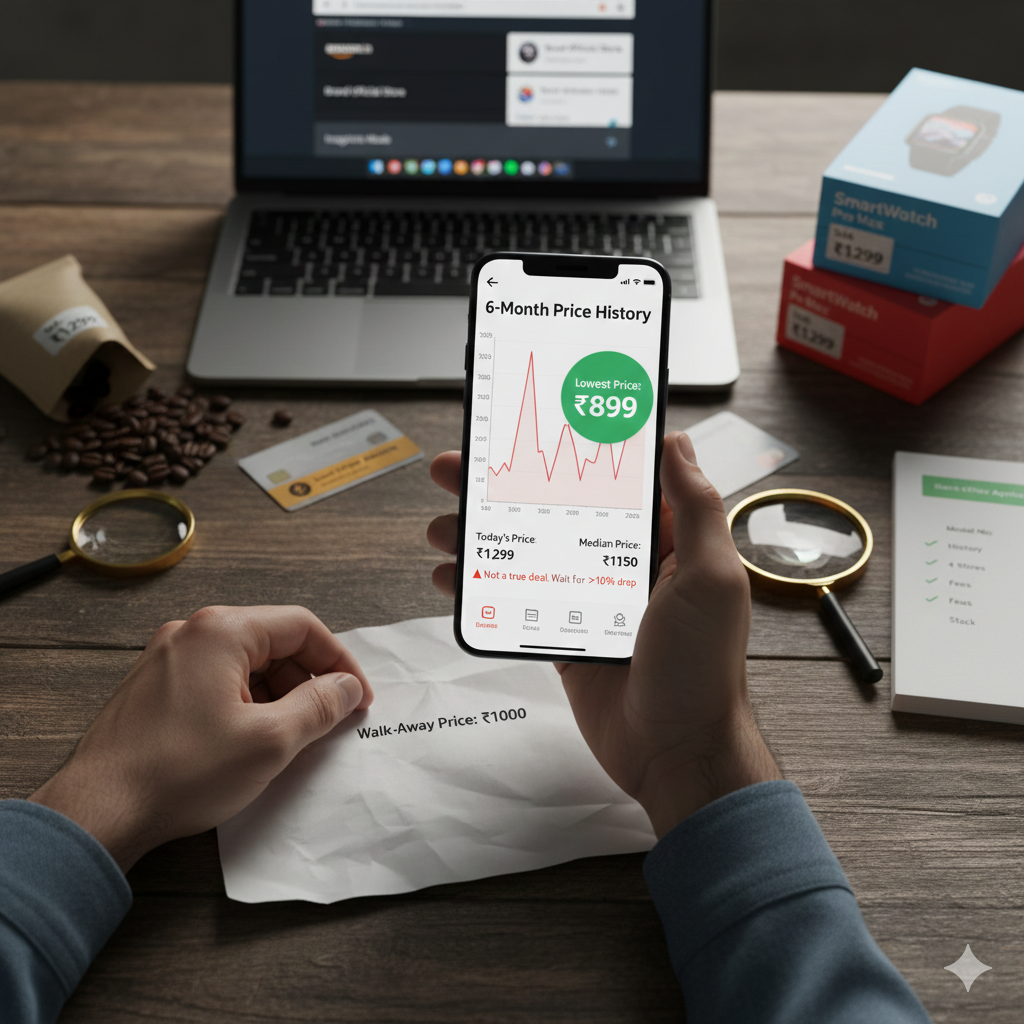
- The Fix: **Ignore the MRP completely.** Compare the current price against the median price it has sold for over the last 90 to 180 days (you need a price-history tool for this). If today’s price isn't at least 10–20% below that median price, it’s just marketing noise.
3. The Illusion of Scarcity: "Only X Left!"
- The Trick: Rolling counters, "Just sold moments ago," or "Only X left in your area."
- The Reality Check: Many of these counters are session-based nudges programmed to increase your FOMO, not live warehouse stock figures.
- The Fix: Try changing your pincode, switching to a different device, or opening an incognito window. If the stock message magically morphs or disappears, you know it's a behavioral nudge, not a fact.
4. Lightning Deals That Never Really End
- The Trick: "Ends in 01:59:58!"—and then the exact same deal pops up again tomorrow, or next week.
- The Reality Check: Rotating deal slots are simply used to make the standard, old prices feel temporary and exclusive.
- The Fix: Screenshot the deal. Revisit the site later. If the deal cycles back constantly, you have proof: the timer isn't an ultimatum, it's just theater.
5. Coupon Bait & Bad Math
- The Trick: Advertising an "Extra 10% Off" on a price that the platform quietly raised 15 minutes before the sale started.
- The Reality Check: The supposed "discount" is calculated from a freshly inflated base price. You’re often back to Square One.
- The Fix: You need to do the math yourself. Compare the final payable amount, or **landed cost**, across all stores after applying the coupon, bank offer, and factoring in shipping/taxes.
6. Bundles You Never Asked For
- The Trick: Adding a mandatory case, a screen guard, "priority shipping," or damage protection—boom, instant inflated "value" and a higher sticker price.
- The Reality Check: You end up paying more for items you wouldn’t have bought individually.
- The Fix: Try to strip the bundle first. If the price of the core product isn’t lower than its normal price when bought alone, it’s not a deal.
7. Drip Fees at the Checkout
- The Trick: Luring you in with a cheap headline price, only to have fees appear at the last step: convenience fees, platform fees, return pickup charges, or mandatory installation costs.
- The Reality Check: Your amazing "deal" shrivels up and dies right on the final checkout screen.
- The Fix: Always compare the final screen totals between stores—make sure the pincode and delivery type are identical.
8. Old Models Disguised as Steals
- The Trick: Huge flash-sale banners promoting last year's devices just weeks before the new model is announced.
- The Reality Check: The price will almost certainly crash much further once the new version is officially released and hits the market.
- The Fix: Check online launch calendars. If a successor is imminent, waiting is the best deal of all.
9. Vague Open-Box/Refurb Terms
- The Trick: A massive price slash, but the fine print reveals it’s refurbished or open-box with a deeply limited warranty or a strict no-return policy.
- The Reality Check: These can be good buys, but only if the terms are crystal clear.
- The Fix: Look for a written warranty (preferably brand/partner), a clear return window, and confirmation that all essential accessories are included. If any of these are vague, skip it.
10. Personalized Pricing & Pincode Games
- The Trick: Prices shift based on your browsing, cart, and location.
- The Reality Check: The “sale price” might be for you, not a universal deal.
- The Fix: Check in incognito, change pincode, clear cart/wishlist. Confirm price across at least 3–4 stores (Amazon/Flipkart/Brand/Croma–Reliance Digital).
🏆 What a REAL Flash Deal Looks Like
- Price History Wins: The price is clearly lower than the 90–180 day median (not just the MRP).
- Landed Cost Beats All: The final cost, after all coupons and fees, handily beats all competitors.
- Clean Terms: The return and warranty terms are standard (no hidden restocking traps).
- No Forced Bundle: You can buy the core product alone at the low price.
- No Cycling: The same price doesn't magically reappear every few days.
⏱️ The 5-Minute “No-Regret” Checklist
- ✅ Find the **Model/SKU**. Search with this exact code—names are marketing, SKUs are truth.
- ✅ Pull **Price History**. If today’s price isn't at least 10–20% below the median, wait.
- ✅ Do a **4-Store Sweep**. Amazon, Flipkart, the brand site, and one big offline chain site.
- ✅ Calculate **Landed Cost**. Add shipping/fees, minus coupons + bank/UPI offers + wallet points.
- ✅ Read the **Policy**. Check returns, pickup fees, and warranty type.
- ✅ Set a **Walk-Away Price**. If the cart doesn’t hit your number, you walk. No FOMO.
When to Actually Buy
- Major Festival, Payday, or End-of-Season events.
- A new model has **just launched** (the old model dips properly).
- Official brand-wide promos (not just platform banners).
- Clear price leadership (one store wins by $\ge 10\%$ on landed cost).
Bottom Line: Flash sales are a sophisticated psychology show: timers, fake inventory, inflated MRPs. A real deal doesn’t need drama—it wins on history-verified price, clean math, and fair terms. Spend five calm minutes with the checklist above and you’ll stop overpaying—even during the loudest flash sale of the year.