Stop Overpaying: How to Check the REAL Product Price Before You Buy
A No-Nonsense Guide to Price History Tools & Comparison Hacks
If you're shopping online without checking the actual price history, you're just playing into the seller's hand. Apps love to inflate the Maximum Retail Price (MRP), throw up aggressive “today only” banners, and use countdown timers to make you rush. Take a breath. Five minutes of smart checking can easily save you hundreds, or even thousands.
Here is the clean, repeatable system I personally use to find the genuine best price—and avoid falling for those clever, but ultimately fake, discounts.
1. Start with the Model Number, Not the Product Name
Sellers are masters at renaming listings to dodge direct comparisons (think "SmartWatch Pro Max 2025 Edition"). The model or SKU (Stock Keeping Unit) is your **only reliable anchor**.
- Grab the code from the specs or "more details" area.
- Use that exact code when you search across different stores.
Heads Up: If a product, especially in fashion, accessories, or small electronics, doesn't clearly list a model number, be extra cautious. That's usually a red flag.
2. Pull the Price History (The Last 3–6 Months)
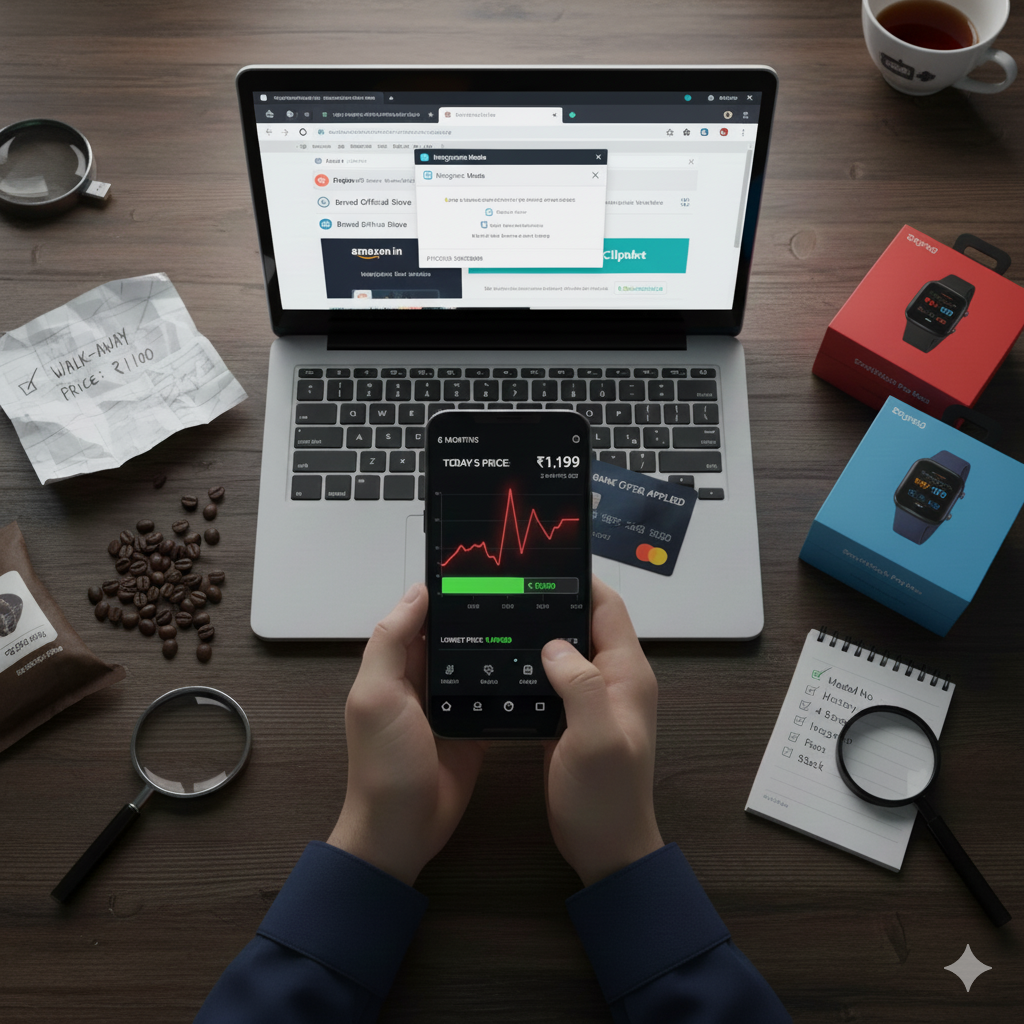
A price "drop" today means nothing without context. You need a tracker or browser extension to show you a graph of historical prices. This will immediately expose fake high prices and let you pinpoint the genuine festival lows.
What to Really Look For:
- The Median Price: What does this item usually sell for, ignoring the hyped MRP?
- Seasonal Lows: What was the price during the last Big Billion Day, Prime Day, or End-of-Season sale?
- Fresh Model Impact: Older models often crash in price quietly right after a new version is announced.
Quick Rule: If today’s price is within 5–7% of the average (median) price, it’s not a true deal. Unless you absolutely need it today, just wait for the next sale window.
Tip: Search for "price history extension + [Your Favorite Shopping Site]" to find the right tool.
3. Do a Quick Four-Store Sweep (Takes Just 2 Minutes)
Open four browser tabs and check your product (using that model number!):
- Amazon
- Flipkart
- The Brand’s Own Store (They often run silent coupons or offer freebies.)
- A Reliable Offline Chain's Website (Like Croma, Reliance Digital, etc.)
Why this works: Prices rotate constantly. Amazon wins today; Flipkart takes the lead tomorrow. The brand site might bundle a free case, and offline chains sometimes offer easier exchanges or a better extended warranty.
4. Kill the Personalized Price Bias
Platforms are constantly tweaking prices based on your past behavior. You need to neutralize this:
- Search using an **incognito or private window**.
- Clear out your cart or wishlist before checking the final price.
- Try checking on a second device or using mobile data instead of Wi-Fi.
- Toggle the pincode—prices can shift by location due to stock or shipping costs.
5. Read the Fine Print Price (The Hidden Costs)
The flashy "sticker price" is rarely the final amount. Always compare the **landed cost**—what it takes to get the product in your hand, risk-free:
- Shipping/handling fees.
- Platform or convenience fees.
- Return pickup fee or restocking fee (common with electronics).
- The warranty type (Is it seller-backed or a full brand warranty?).
- Any necessary add-on costs you actually need (case, screen guard, professional installation).
Fact: A ₹500 cheaper listing with a strict no-return policy is absolutely not cheaper.
6. Stack Your Discounts: Bank + UPI + Coupon (The Right Way)
Most people apply one code and stop. You can often stack three layers of savings:
- Coupon: The standard site/app coupon code.
- Payment Offer: The bank offer (SBI/HDFC/Axis) or UPI cashback.
- Wallet/Points: Amazon Pay, PhonePe, or credit card reward points.
The Order Matters: Apply the coupon first $\rightarrow$ Select your payment offer $\rightarrow$ Redeem wallet/points at the final checkout.
(Seriously, many carts will let all three work together. Always test it.)
7. Check the Unit Price, Not the Pack Price
This is essential for groceries, health, and beauty items. Always compare the ₹ per 100g, 1kg, 1L, or 1 piece. Bigger packs are a mental trick and aren't always cheaper. Look for the "details" section—sneaky sizes are a classic move.
8. Don't Pay More for Cosmetic Variants
It sounds ridiculous, but the "Red" version might cost $₹1,499$ while the identical "Blue" is $₹1,199$. Same product, different demand. Sort the same model by colour or size and just pick the cheapest one.
9. Verify the Seller Quality Before Chasing ₹100 Off
A small bargain from a fly-by-night grey seller could cost you weeks of return hassle. Prioritize these sellers:
- Listings with “Fulfilled/Assured” badges.
- Brand-authorized official stores.
- Look for recent reviews with real photos (filter by “Most recent” and “1★–2★” to spot common issues quickly).
10. Use Refurbished & Open-Box Strategically
If you’re comfortable with it (and the platform is reliable), open-box or certified refurbished products can slash prices by 20–40%. Just ensure:
- A written Brand or Partner Warranty is included.
- There is an easy, clear return window.
- All essential accessories (like the charger) are included.
11. Time Your Buy: The Calendar Beats the Coupons
If you have the luxury of waiting, these windows deliver the deepest, most genuine drops:
- End of the Month: Sellers hit targets, often with silent payday promos.
- New Model Launches: The previous model’s price quietly dips.
- Major Festival Sales: Diwali, New Year, or Back-to-School.
- Brand Anniversaries: Apple Days, Samsung Days, etc.
Log your target price, then patiently wait for the right window.
12. The Offline Cross-Check (The 15-Minute Hack)
Call two local electronics or general stores. Quote the online price you found, and then ask this simple question: “Can you match or beat that price with a proper bill?”
You will be surprised how often they say yes—and you get the benefits of same-day pickup and super-easy exchanges.
13. Decide Your Walk-Away Price
Before you even start searching, write down one firm number: “I will buy at ₹____ or less.”
When the checkout cart starts playing those mind games with you, stick to your number. If the price doesn’t hit your target, you walk. No FOMO.
✅ Quick Checklist (Save This to Your Phone)
- Search by **model number/SKU**.
- Pull **3–6 month price history**.
- Compare **4 stores** (including the brand site).
- Use **incognito mode** + check different **pincodes**.
- Calculate the **landed cost** (fees/returns/warranty).
- **Stack** coupon + bank + wallet layers.
- Check the **unit price** and variant pricing.
- Prefer **authorized** and 'Fulfilled' sellers.
- Time your buy for **calendar lows**.
- Stick to your **walk-away price**.