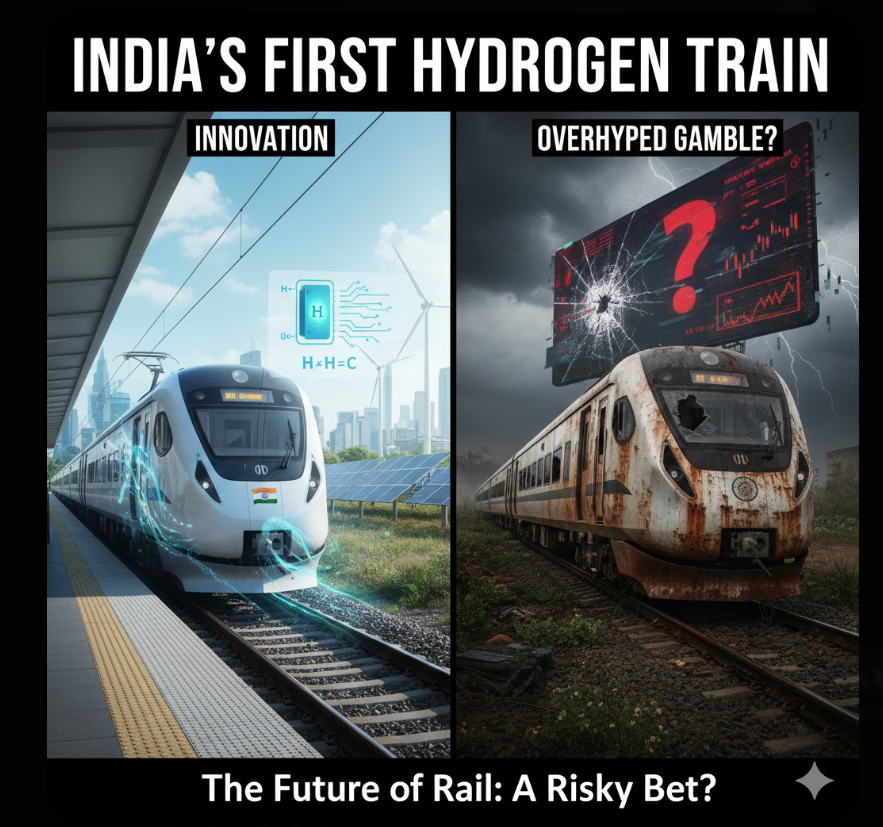
India’s First Hydrogen-Powered Train — Facts Over Hype
This isn’t magic. It’s engineering discipline finally executed after years of delay. Here’s the train, the tech, and the impact—minus the noise.
Baseline
Indian Railways has completed pilot manufacturing of its first hydrogen-powered train as per RDSO specs. People are calling it a “historic leap.” The truth: India is late, but at least it’s moving. Hydrogen transport isn’t new; others deployed it years ago. India can avoid their mistakes, but the gap won’t vanish overnight.
The “Made in India” part matters this time: designed, prototyped, and built domestically. The 10-coach set claims a 2,400 kW output. Impressive on paper—irrelevant if operations don’t prove reliability. Hydrogen traction demands precision; press releases don’t run trains, execution does.
What Actually Matters — Top 5
-
Zero Emissions ≠ Automatic Sustainability
Tailpipe is clean—only water vapor. Sustainability depends entirely on fuel origin. If hydrogen is made from coal or gas, the “green” claim collapses. Without scaled green hydrogen, this is PR, not progress.
-
The Broad-Gauge Reality
India’s broad-gauge network needs more power and stronger design. Calling the longest broad-gauge hydrogen train a “record” is spin—it’s a requirement. 2,400 kW barely meets baseline needs.
-
First-Time Hydrogen Traction = High Risk
Prototyping is easy. Real routes with variable loads, extreme weather, mixed gradients, and aging signaling are the test. If it can’t survive real-world pressure, it joins the graveyard of abandoned pilots.
-
Manufacturing Done. Deployment Isn’t.
“Ready” doesn’t mean “running.” Approvals, safety certification, crew training, hydrogen stations, and supply chain aren’t in place. Without reliable refueling on major corridors, this is a metal showpiece.
-
Cost Will Decide
Fuel cells, storage, safety systems, refueling infra—none of it is cheap. India loves low-cost operations; hydrogen isn’t that. Without consistent long-term funding, the project stalls after the pilot.
The Only Question That Matters
Will India follow through with ruthless, continuous execution, or celebrate the pilot and then drift? Scale, maintenance discipline, fueling reliability, and cost control will decide whether this transforms operations or becomes another headline artifact.
Don’t worship announcements. Performance data or it didn’t happen. Prove sustained operations at scale or stop calling it a revolution.
Conclusion
This hydrogen train is a critical step—only a step. No miracle. No shortcut to sustainability. No instant revolution.