Amazon Layoffs: Is AI Quietly Replacing Human Jobs?
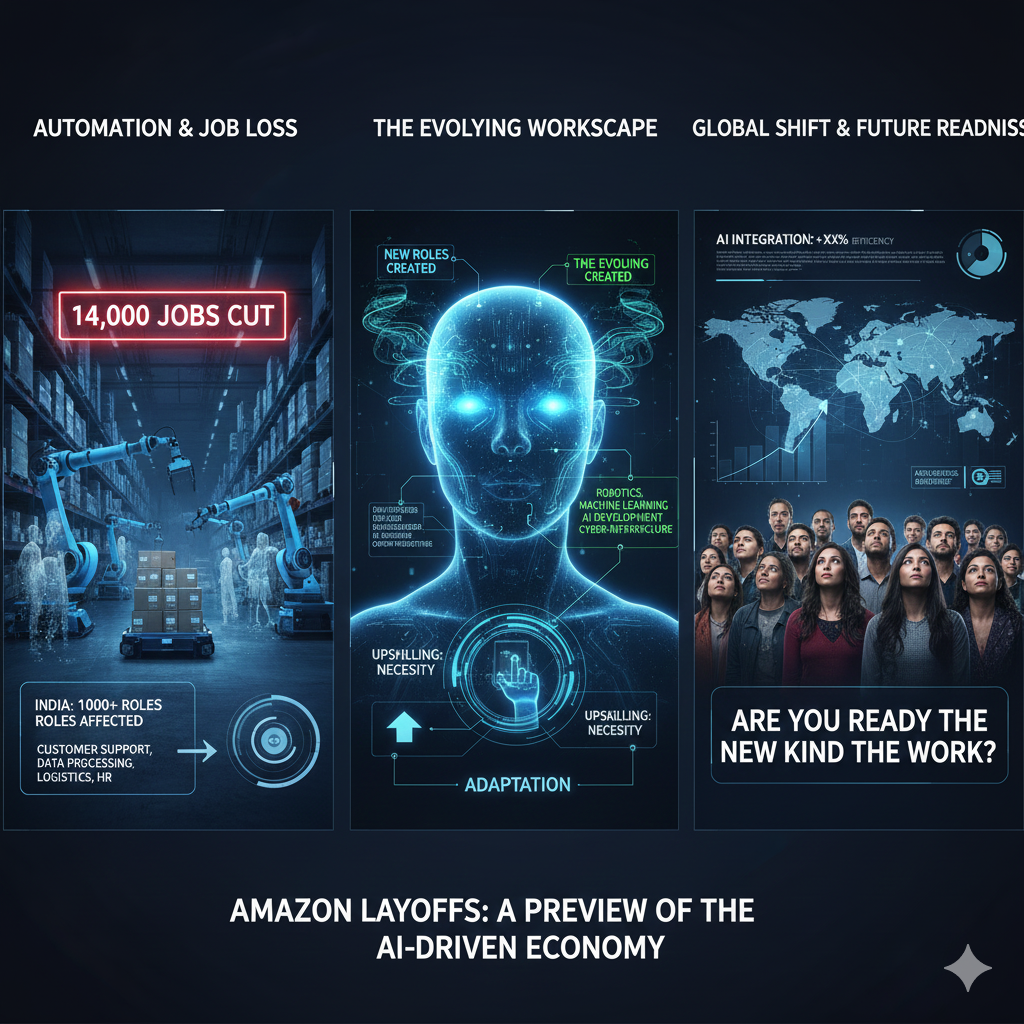
Amazon has sent a shock through the global job market once again, confirming that nearly 14,000 employees will be let go as part of a major internal reshuffle. What has made this round of layoffs spark even more debate is the growing role of artificial intelligence in the company’s decision-making. With each update, the same question keeps coming up: are we watching the early stages of machines quietly taking over work that was once done only by people?
For many industry watchers, this announcement didn’t come out of the blue. Amazon has spent years building smart warehouses, introducing automated systems, and integrating AI tools across its divisions. But this wave of job cuts—one that may grow larger over the coming year—has given the world one of the clearest signals yet of how quickly AI is reshaping corporate structures.
Reports suggest that the impact will be felt heavily in India as well, with at least 1,000 employees likely to be affected.
Hints of this shift were visible earlier. Back in June, Amazon CEO Andy Jassy had openly said the company would be leaning more aggressively into generative AI. His statement suggested that some existing roles would shrink, while new kinds of jobs would appear in their place. At the time, the message sounded carefully balanced. But today, the scale of the layoffs suggests the transformation is moving faster than many expected.
Amazon is not alone in this shift. Across Silicon Valley and major global corporations, the economic slowdown has pushed companies to cut costs and rely more heavily on automation. When productivity becomes a priority, AI feels like an obvious solution—it doesn’t tire, doesn’t need promotions, and can process enormous amounts of data in minutes.
However, the conversation is larger than just job losses. Many experts argue that while AI will certainly replace some roles, it will also create new ones—just like earlier industrial revolutions did. The real concern is the widening gap between the skills people currently have and the skills needed for the new wave of jobs.
In Amazon’s case, even as thousands of positions are being removed, the company is actively hiring in highly specialised areas such as robotics, machine learning, cyber-infrastructure, and AI development. These roles demand advanced technical knowledge—something many of the affected employees may not yet possess.
Customer support, data processing, logistics coordination, HR operations, and content moderation are some of the roles most vulnerable to automation.
But India also stands to benefit enormously. The future isn’t only about losing jobs—it’s also about shifting into entirely new kinds of work. So, is AI replacing people? The honest truth is: yes, it is—slowly but steadily. But it’s not wiping out the workforce overnight. Instead, it’s pushing industries to reorganise.
The real challenge for workers now is adaptation. Learning new skills is no longer an option—it’s necessary. Those who find ways to work alongside AI will grow, and those who hold on to old systems may find the coming years more uncertain.
Amazon’s layoffs are not just a corporate announcement—they are a preview of what the global job market is heading toward. AI is no longer something companies are “experimenting” with. It’s active, expanding, and redefining how businesses operate. The question people should be asking themselves now is not “Will AI take my job?” but “Am I ready for the new kind of work that’s coming?”